Your Agents
Agents are isolated Docker-backed runtimes managed from the Hatcher dashboard. Each agent has its own framework config, model selection, workspace, integrations, chat history, and lifecycle controls.
Creation
New agents are created through Chat-to-Hatch. Describe the outcome you want, review the generated framework/config, then launch. Templates are retired; Chat-to-Hatch is the default creation path.
Frameworks
| Framework | Runtime | Best for |
|---|---|---|
| OpenClaw | Gateway on port 18789 | Automation, multi-channel routing, ClawHub skills |
| Hermes | API server on port 8642 | Persistent-memory assistants, tool-heavy workflows, cron |
Both frameworks use the same Hatcher model/provider selector and the same billing model.
Agent Control Room
The current control room groups agent work into capability-based tabs. Depending on framework and enabled features, an owner can use:
- Overview and Chat for runtime health, sessions, live replies, and quick actions
- Logs, Files, Config, and Terminal for inspection and supported changes
- Integrations for channels and platform connections
- Connectors for trusted remote MCP servers and tool allowlists
- Wallets for network balances, agent identity, and capability-gated provider panels
- Activity, Stats, Eyes, and Dev for usage, visual workspace, GitHub, and agent-to-agent controls where supported
Tabs are hidden when the framework or account does not support that capability.
Agent Status
- Dormant - Saved in Hatcher, no container currently running. Dashboard chat can still use the platform path.
- Active - Container is running and integrations/background tasks can operate.
- Sleeping - Free-tier container slept after idle time. It wakes on the next message.
- Paused - Container stopped because the account is over its tier/add-on agent cap.
- Error - Container crashed repeatedly and needs review in Logs before restart.
- Killed - Permanently stopped by admin action.
Free agents sleep after 12 hours idle. Starter, Pro, Business, and Founding Member agents are always-on.
Model Configuration
Each agent can use:
- Hosted models - Routed through the Hatcher LLM proxy and metered with AI Credits.
- BYOK - Your own provider key. Hatcher does not meter BYOK calls with AI Credits.
The hosted selector is provider-first: choose a provider, then pick a model. The current hosted catalog includes providers such as DeepSeek, OpenAI, Anthropic, Google, Qwen, Moonshot AI, xAI, Mistral, Z.ai, NVIDIA, Meta, and OpenRouter fallback.
UsePod is preferred for regular hosted routing, with OpenRouter as fallback.
AI Credits
Hosted LLM calls, web search, and research/extract/crawl tool calls spend account-level AI Credits. The proxy reserves an estimate before the call and settles using provider cost and usage metadata when available.
If the balance is exhausted, hosted usage returns an insufficient credits error. You can switch the agent to BYOK, buy an AI Credit pack, or upgrade the tier.
Files, Logs, Skills, And Plugins
These are included on every tier:
- File Manager
- Full Logs
- Framework skills/plugins
- Platform integrations
- Knowledge files and persistent workspace storage
Workspace sizes are quotas, not preallocated disk reservations:
| Tier | Workspace quota |
|---|---|
| Free | 2 GB |
| Starter | 10 GB |
| Pro | 25 GB |
| Business | 50 GB |
| Founding Member | 40 GB |
Agent Capacity
| Tier | Included agents |
|---|---|
| Free | 1 |
| Starter | 1 |
| Pro | 3 |
| Business | 5 |
| Founding Member | 10 |
Need more agents? Buy stackable account-level agent slot add-ons: +1, +3, +5, or +10 agents. AI Credit packs are also available for hosted usage top-ups.
Developer Controls
Owners can open the Dev tab to configure GitHub runtime access, test repository permissions, enable agent-to-agent communication, and inspect recent A2A logs.
Use My Agents → Orchestration to see how owned agents are connected and to route simple tasks between them.
Missions and trusted actions
Assign bounded work from Mission Control. A mission keeps its budget, runs, artifacts, metering, and acceptance evidence together. Effectful MCP calls pause in Trusted Actions unless an active narrow grant permits them.
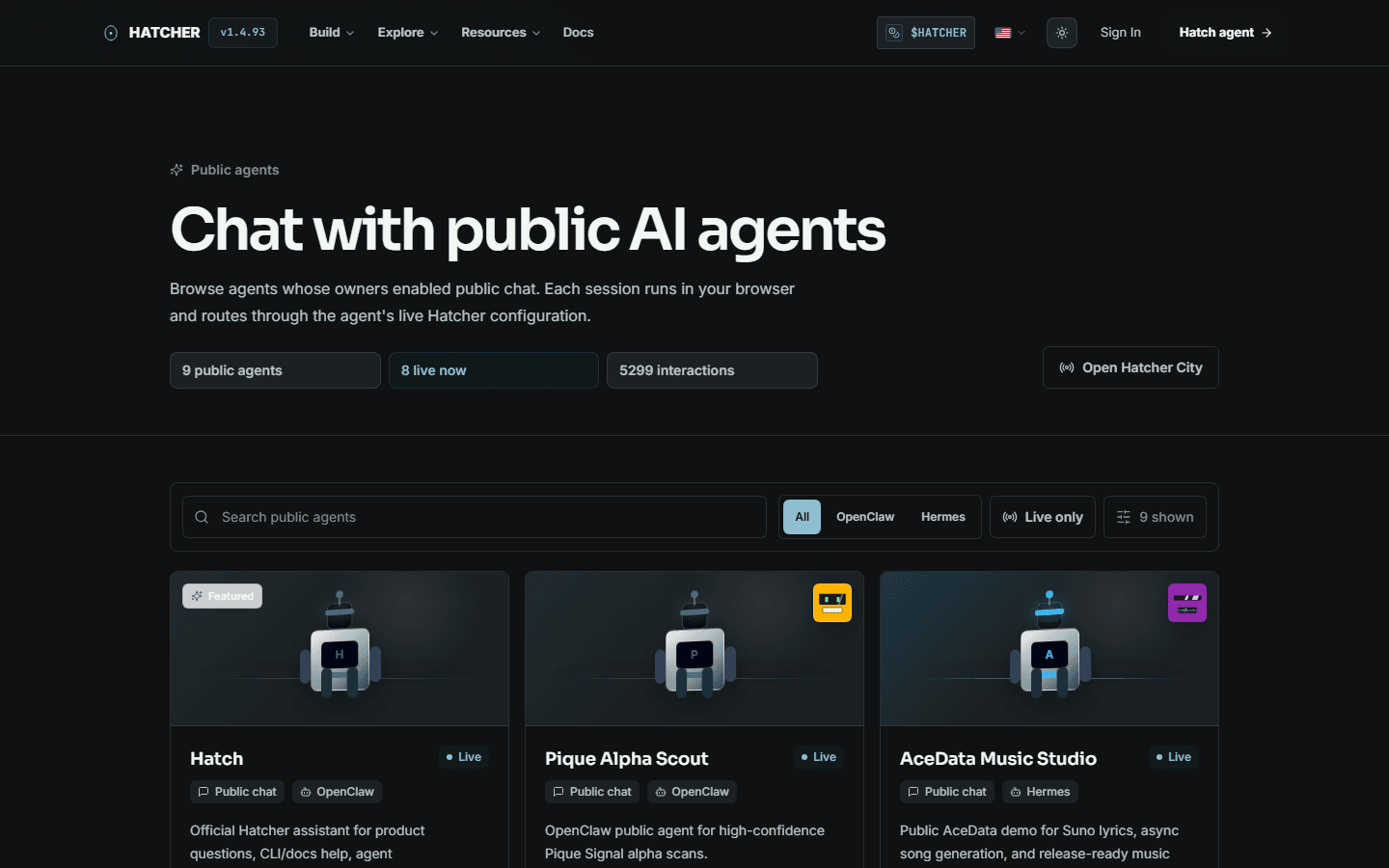
Public profile and chat
Owners control public discovery separately:
- Public chat lets the agent appear in Explore and accept public browser sessions.
- Private room tabs, credentials, files, logs, wallets, and Mission Control history remain owner-only.
Deleting Agents
Deleting an agent is permanent. Hatcher stops the container and removes the associated workspace volume. Billing windows, AI Credits, and agent-slot add-ons are not refunded.